
In today’s digital marketplace, independent auto repair shops face the constant challenge of attracting local customers while competing with large franchise chains, dealerships, and other independents. Google Local Service Ads (LSAs) have emerged as a powerful tool for repair shops looking to connect with potential customers actively searching for automotive services. Unlike traditional advertising methods, LSAs put your business front and center when customers are ready to book service, making them particularly effective for repair shops.
Understanding Google Local Service Ads
Google Local Service Ads operate differently from standard Google Ads. Instead of paying per click, auto repair shops pay per lead—meaning you only pay when a potential customer contacts your business directly through the ad. This model is ideal for independent auto repair shops because:
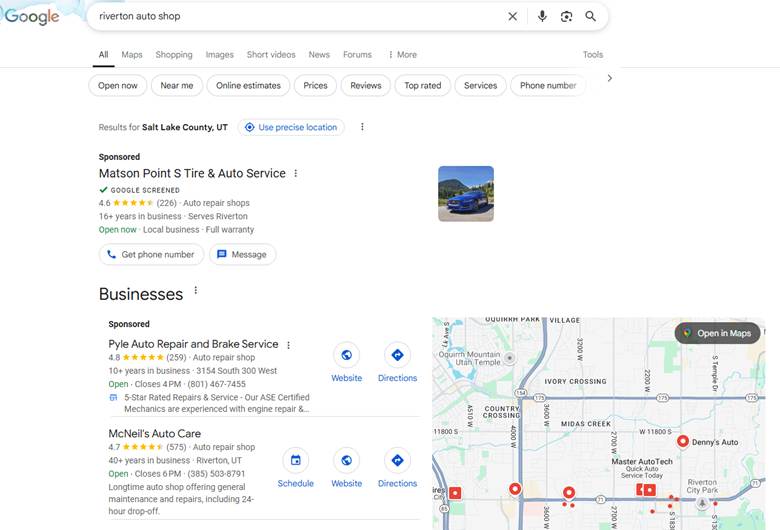
- Your business appears at the very top of Google search results with the “Google Guaranteed” badge
- Customers can see your shop’s name, rating, hours, and services at a glance
- You only pay when someone contacts you about an actual service need
- Leads are typically higher quality since customers are actively seeking repairs
- LSA’s have a positive bias towards voice searches and are integrated with Google Assistant powered devices taking advantage of the trend towards voice versus text searches
The Google Guaranteed badge is particularly valuable for auto repair shops, as it helps build trust with potential customers who might be wary of visiting a new shop. Google’s vetting process, which includes license and insurance verification, background checks, and customer reviews, provides added credibility.
The approval process does take some effort, but the additional business you get from these leads is worth the trouble.
Understanding When My Local Service Ad is Seen
Google Local Service Ads operate on different ranking principles than traditional ads or organic search results.
Key Ranking Factors
- Proximity – How close your business is to the searcher’s location
- Review rating and volume – Higher ratings and more reviews generally lead to better placement
- Responsiveness – How quickly and consistently you respond to leads. Missed calls and messages left unanswered are a significant hindrance to future ad visibility
- Business hours – Whether you’re open when someone is searching
- Bid amount – While not the primary factor, your bid affects positioning
- Booking rate – The percentage of leads that convert to customers
- Profile completeness – Higher quality profiles, including those with images, may rank higher and may also pay lower costs per lead. Use of high-quality images, and any other information about your business that may influence user preferences factor into profile quality.
When LSAs Are Displayed
LSAs appear at the very top of search results when:
- A user searches for services you offer in your service area
- The search has clear local service intent (auto repair near me, closest tire shop, etc.)
- Google LSAs are available for that particular service category in that location
- There are qualified providers who have set up LSAs in that area
When you are ready to get started it is as simple as going to https://ads.google.com/localservices and clicking on the sign-up link.
Setting Up Your Auto Repair Shop’s LSA Profile
Creating an effective LSA profile requires strategic thinking about how to represent your shop’s services and capabilities.
Business Profile Description: Google limits what you can place in the “Business Bio” section. Check the boxes for what service/features/amenities that your shop offers. You also have the option of adding your website URL. I highly recommend that you do not leave this blank. You can use your homepage, but alternatively you can build a specific landing page tailored to convert your LSA leads. Focus on what makes your shop unique. Highlight ASE certifications, shuttle and concierge service, specializations (European vehicles, diesel engines, etc.), and your shop’s experience. Avoid generic descriptions; be specific about why customers should choose your shop over competitors.
Another thing to make note of when setting up your profile initially is to use your primary phone number. Google does not make it easy to change the phone, if they will even let you without starting over, and so avoid using tracking numbers. Marketing tracking numbers can change over time and when that happens you will run into issues of receiving phone leads.
Ad Schedule: You have three options of when your ads will be seen.
- Business Hours – Ads will only be shown during business hours.
- All Day – Just as the title describes. You can receive leads 24/7
- Custom – You can pick whatever window that you choose.
The best advice is to pick whatever option that you can be the most responsive. Google monitors responsiveness and if you miss calls or wait 48 hours to respond to a message future ads will get lower visibility. Generally, you will want to pick Business Hours unless you have an established answering service in place.
Notification Settings: This section will allow to select if you accept message leads and how you want to be notified of leads (text and/or email). It is best to accept message leads, but only if you ensure that your Service Advisors promptly respond.
This section also allows you to toggle if your ad will be show if someone directly types your business name into the search bar. The nice thing about selecting this option is that you will not be charged for existing customers. This does require you to monitor your leads for existing customers as Google won’t always flag customers already in your database.
Shop Photos: Include high-quality images that showcase:
- Clean, well-organized service bays
- Modern diagnostic equipment
- Certified technicians at work
- Your customer waiting area
- Before/after repair examples
Always keep the branding of your shop in mind and the types of vehicles and customers that you want. Don’t fall into the trap of posting whatever random photos you have sitting on your computer. Also, don’t post a bunch of exotic cars overlooking the ocean if you are a general service shop located in the mountains that has never seen an exotic in your bays. While these photos may look great, they don’t represent your shop or your customers and can hurt conversion.
If you have it in your budget hiring a local photographer is a great idea to give you a catalog of images to use throughout your marketing, not just your LSA profile. Photographers can typically be found for an affordable price on places like Facebook Marketplace and Craigslist and provide dividends into the future. However, even taking the time and taking quality photos with your smartphone will yield better results than random stock images.
Job Types: Be precise about which services you offer. Google pre-populates options you can select based off the industry selected. The two most common categories our clients use are Auto Repair Shops and Tire Shop. The sub-categories currently include:
| Auto Repair Shop | Tire Shop |
| Brake Repair | Tire Alignment |
| Electrical System Repair | Tire Repair |
| Exhaust System Repair | Tire Rotation |
| Transmission Repair | Tire Balancing |
| Car Maintenance | Tire Replacement |
| Engine Repair | Other |
| Other |
Ensure that you are not selecting services you don’t provide (e.g. if you don’t do alignments leave it unchecked). If you select something that you don’t provide it is going to end up as wasted budget and time responding to leads from customer’s that are looking for services you don’t offer.
Service Areas: These are the locations that your ads will be shown. The targeting is more limited than traditional Google ads. The narrowest you will be able to target will be by zip code and city. You can exclude areas as well if they overlap with some zip codes.
The best method is to focus on your most valuable zip codes. If you stretch out too far your conversions will likely drop and you will waste budget marketing to those that are less likely to drive to your shop.
Budget Management Strategies for Independent Shops
Setting and managing your LSA budget requires careful attention to seasonal demand, your shop’s capacity, and bidding strategies.
Starting Budget: Most independent shops find success starting with a budget of $1,000-$2,000 per month, adjusting based on results and capacity. This amount can be highly variable and may require some testing on your part to get the best ROI on your ad spend.
Seasonal Adjustments: If your shop experiences seasonal fluctuations then it may be a good idea to adjust your budget accordingly. For example, if you are so busy during the summer months that you can’t catch your breath and can’t possibly take another car in then it may make sense to reduce your budget. This is highly situational and you should be mindful of how you adjust your budgets. There is currently not an option to automate this so you will need to adjust manually (and be careful to not forget to adjust back up or down)
Understanding Bidding Strategies for Auto Repair LSAs
Google offers three primary bidding approaches for Local Service Ads, each with distinct advantages for auto repair shops:
1. Automated Bidding Without Target Cost-Per-Lead
This “maximize leads” approach allows Google’s algorithm to automatically adjust your bids to generate the maximum number of leads within your budget.
Benefits for repair shops:
- Simplifies management for busy shop owners
- Automatically adjusts to competitive pressures in your market
- Helps capture emergency repair leads when competition increases
- Ideal for shops just starting with LSAs
Drawbacks:
- May result in higher cost-per-lead
- Less control over spend efficiency
- Could deplete budget quickly during high-demand periods
Best for: New LSA advertisers, shops in highly competitive markets, or businesses focusing on volume rather than cost efficiency.
2. Automated Bidding With Target Cost-Per-Lead
This strategy allows you to set a target maximum cost you’re willing to pay per lead, while Google’s system optimizes to stay within that target.
Benefits for repair shops:
- Better cost control while maintaining automation
- Good middle-ground approach for established shops
Drawbacks:
- May miss opportunities when competition increases
- Requires historical data to set appropriate targets
- Different repair services have varying value (a transmission rebuild lead is worth more than an oil change lead). Challenging since Google does not allow target CPA by specific service, only by industry
Best for: Shops with established LSA accounts and clear understanding of lead value by industry type. Set different target CPLs based on service industries.
3. Manual Bidding
This approach gives you complete control over bid amounts, allowing you to set exactly how much you’re willing to pay per lead.
Benefits for repair shops:
- Maximum control over spending
- Ability to adjust bids based on shop capacity (lower when booked, higher when bays are empty)
- Can respond quickly to seasonal trends specific to your market
- Allows for sophisticated strategies based on your CRM data
Drawbacks:
- Requires regular monitoring and adjustments
- Needs data analysis to optimize effectively
- More time-consuming than automated options
Best for: Experienced LSA advertisers, shops with dedicated marketing management, or businesses with highly variable capacity and seasonal fluctuations.
Managing and Responding to LSA Leads
How you handle incoming leads dramatically impacts your conversion rate and Google ranking:
Response Protocol: Create a standardized process for handling LSA inquiries:
- Respond within 5-10 minutes (faster response rates significantly improve conversion)
- Ask probing questions to qualify the lead
- Offer a specific appointment time rather than asking when they want to come in
- Document all communication in your CRM
Service Advisor Training: Ensure your front desk staff understands:
- How to identify and prioritize LSA leads in your system
- The importance of quick, professional responses
- How to convert price-shopping inquiries into appointments by emphasizing value
- Proper documentation procedures in your CRM
After-Hours Strategy: Independent shops often lose emergency repair opportunities to shops with 24/7 service. Consider:
- Using a call service that can schedule appointments for the next day and/or organize towing service
- Implementing a text response system for after-hours inquiries
- Creating a clear protocol for emergency repairs that occur outside business hours
Optimizing for the Google Algorithm
Your LSA ranking directly impacts lead volume. Google’s algorithm prioritizes shops that:
Respond Quickly: Aim to respond to all inquiries within 5-10 minutes. Response time is one of the most heavily weighted factors in Google’s LSA algorithm.
Maintain High Ratings: Consistently earning 4-5 star reviews is essential. Create a systematic approach to requesting reviews from satisfied customers through your CRM.
Complete Jobs: Google tracks whether leads result in completed jobs. Update the status of every lead in your Google LSA dashboard to demonstrate high completion rates.
Handle Disputes Properly: When customers contact you about services you don’t provide or outside your service area, properly dispute these leads through Google’s system rather than ignoring them.
Existing Customers: If you have enabled “Direct Business Search” in the settings menu then you need to monitor your leads against your customer database. Google doesn’t catch all of these so, if an existing customer is contacting you through the ad make sure that you flag this on the “Rate this lead” link so you don’t get charged for the lead.
Rate & Archive Leads: Using the rate and archive leads functions will help train the algorithm to send you the right leads. Being consistent in this process will ensure that you are being sent the best quality leads for your shop.
Leveraging Your CRM System with LSAs
Your shop’s Customer Relationship Management (CRM) system is the key to maximizing LSA effectiveness. Integration between these systems creates a powerful lead management solution
Lead Import: Configure your CRM to import LSA leads. This prevents leads from getting lost and ensures prompt follow-up.
Lead Source: When an LSA lead comes into your shop ensure that you are marking their Customer Source as LSA. This will allow you to target and analyze the data from these customers in the future within your shop management system and CRM.
Automated Follow-up: Create specialized follow-up sequences for different types of repair inquiries
- Emergency repairs (same-day contact)
- Diagnostic requests (appointment scheduling)
- Maintenance services (scheduling with educational content)
Data Analysis: Use your CRM to track vital metrics
- Average repair order value from LSA customers
- Retention rate of LSA-acquired customers
- Service types most commonly requested through LSAs
- Lifetime value comparison between LSA customers and other sources
Customer Lifecycle Management: Program your CRM to:
- Send automated maintenance reminders to LSA customers
- Create targeted service promotions based on vehicle history
- Identify opportunities for additional services
Converting One-Time LSA Customers into Loyal Clients
The real value of LSAs comes from converting first-time customers into longtime clients.
First-Time Customer Experience: Create a memorable first experience:
- Implement a shop tour for new customers
- Provide a complimentary digital vehicle inspection
- Include a small welcome gift (branded microfiber towel, air freshener, etc.)
- Follow up the initial service with a handwritten thank you note
- Follow up with a review request
CRM-Driven Relationship Building:
- Program 30-day follow-up calls to check satisfaction
- Create 3-month maintenance reminder emails
- Send seasonal service promotions relevant to their vehicle
- Implement a loyalty program tracked in your CRM
Feedback Loops: Use your CRM to:
- Send automated satisfaction surveys after service
- Identify and address potential issues before they result in negative reviews
- Track which LSA services most frequently result in repeat business
Measuring Success and ROI
Accurate measurement is critical to optimizing your LSA program.
Key Performance Indicators:
- Cost per lead (average and by service type)
- Lead-to-appointment conversion rate
- Average repair order value from LSA customers
- First-time to repeat customer conversion rate
- Customer acquisition cost vs. lifetime value
Comparative Analysis: Use your CRM data to compare:
- LSA performance against other digital marketing channels
- Performance across different service categories
- Seasonal fluctuations in lead quality and conversion
Continuous Improvement: Regularly review metrics to:
- Adjust budget allocation across service categories
- Modify your response protocols based on conversion data
- Refine your LSA profile based on which services generate the most profitable leads
Common Mistakes to Avoid
Independent shops often make these preventable errors with LSAs.
CRM Disconnection: Not integrating LSA leads with your CRM creates a fragmented customer experience and prevents effective follow-up.
Incorrect Targeting: Only target geographic areas that you see customers from. Expanding too far just wastes budget and time.
Slow Response Times: Delayed responses dramatically reduce conversion rates and lower your ranking in Google’s algorithm.
Disputing Valid Leads: Improperly disputing legitimate leads can damage your standing with Google and affect future lead generation.
Inaccurate or Incomplete Profile: Ensure that you setup your profile completely and accurately. Nothing is worse than having the wrong shop hours or contact information.
Missing Review Request: After you have thoroughly impressed your new LSA client don’t forget to ask for a review. Review count and frequency are one of the ranking factors to ensure you continue to receive more than your fair share of future leads.
Conclusion
For independent auto repair shops, Google Local Service Ads represent a uniquely powerful tool when properly integrated with software like HiBeam CRM. This combination allows you to not only generate new customer leads but to convert them into long-term, profitable relationships.
HiBeam CRM is an essential tool to allow you to get the most out of your LSA budget from initial lead management to ongoing customer communication and retention tools to ensure that you gain a customer for life.
The most successful shops approach LSAs as part of a comprehensive customer acquisition and retention strategy rather than as an isolated advertising channel. By implementing these best practices and creating seamless connections between your LSA leads and HiBeam CRM, independent shops can effectively compete with larger auto repair shops and dealers while building a loyal customer base.
As the automotive repair industry continues to evolve, those shops that master the integration of digital lead generation with systematic customer management will be positioned for sustainable growth and profitability.
Interested in learning how HiBeam CRM and our suite of digital marketing services can improve your business? You can reach us at info@HiBeamCRM.com or Schedule a Demo Here.