
Picture this: A customer’s check engine light has been on for three weeks. They knew they should bring their car in, but they kept putting it off. Now they’re calling in a panic, broken down on the side of the road, trying to get their car towed to you.
Sound familiar? You have seen this scenario play out over and over again in your shop, but this isn’t just about lazy customers or busy schedules. It’s about psychology and recent survey data reveals exactly why customers delay service and how you can turn these challenges into opportunities.
What Customers Are Actually Ignoring
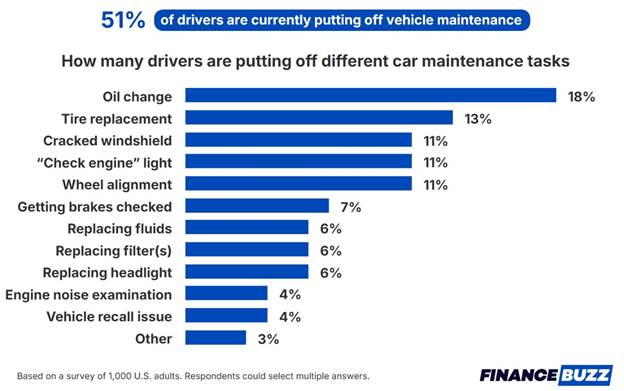
So, what exactly are customers putting off?
The survey revealed why 38% of drivers ignore dashboard warning lights for weeks:
- 53% knew about the issue but believed it was minor and could be addressed later. This represents the classic “still running” rationalization.
- 43% didn’t know the exact issue but felt safe continuing to drive because the car seemed fine. They use current performance to justify delaying professional diagnosis.
- 42% feared the repair would be expensive and beyond their means. Financial anxiety drives avoidance even when customers know action is needed.
The Numbers Don’t Lie
The survey revealed several statistics that every shop owner needs to understand:
- 51% of drivers are currently aware of maintenance their vehicle needs but are putting it off
- 40% of drivers delay getting maintenance done even after they know it’s due
- 51% of surveyed drivers admitted they’ve already paid for a car repair that could have been avoided with regular maintenance
- 38% of drivers have ignored a warning light on their dashboard for more than two weeks
More than one in ten drivers operates a vehicle with safety-critical issues they’re fully aware of. Understanding the psychology behind this procrastination will help you communicate with customers in ways that lead to more work being sold.
The Four Pillars of Customer Purchasing Psychology
To understand why customers delay service, we need to examine the four primary factors that drive all consumer behavior: psychological, personal, social, and cultural influences.
Psychological Factors
Motivation and Hierarchy of Needs
Vehicle maintenance competes with higher-priority expenses like family needs and entertainment. With 58% of drivers unable to afford emergency repairs over $1,000, there’s constant tension between safety and financial security.
Perception and Cognitive Biases
The 53% of drivers who ignore warning lights because they believe issues are “minor” demonstrate classic cognitive biases in action. They engage in:
- Optimism bias – Believing negative outcomes won’t happen to them
- Present bias – Valuing immediate convenience over future consequences
- Confirmation bias – Focusing on the fact that “the car still runs” while ignoring warning signals
Learning from Past Experiences
Consumer learning patterns heavily influence repair decisions. Customers who’ve experienced “surprise” expensive repairs develop learned avoidance behaviors. This explains why 42% delay repairs due to cost fears; they’ve been conditioned to associate automotive service with financial pain.
Beliefs and Attitudes
Customer beliefs about automotive service profoundly impact their behavior. Common limiting beliefs include:
- “If it’s still running, it’s not urgent”
- “Mechanics are trying to sell me things I don’t need”
- “Car repairs are always more expensive than quoted”
Personal Factors
Economic Reality
26% of drivers can’t afford repairs exceeding $500. This creates avoidance behaviors driven by competing financial priorities.
Life-Cycle Stage Impact
Young adults prioritize appearance over maintenance, families balance safety against other expenses, and older adults may delay service due to fixed incomes.
Lifestyle and Personality Traits
Personality significantly influences maintenance behavior:
- Conscientious individuals – More likely to follow maintenance schedules
- Risk-averse personalities – May delay service to avoid financial surprises
- Convenience-oriented consumers – Avoid service unless absolutely necessary
Social Influences
Customers base repair decisions on their social circle’s experiences. Negative stories from friends and family create avoidance patterns, while positive recommendations can overcome psychological barriers.
Cultural Factors in Automotive Behavior
Different backgrounds bring varying maintenance approaches; some emphasize prevention while others focus on reactive solutions. DIY enthusiasts may delay professional service, luxury vehicle owners may have different service expectations and timeline pressures.
How HiBeam CRM Can Break the Cycle
Understanding customer psychology is only half the battle. The right CRM features give you the tools to act on these insights and convert hesitant customers into committed buyers. Here’s how HiBeam CRM’s capabilities can directly improve your sales:
Audience Segmentation – Create custom saved audiences to precisely target customer with the right messaging to drives cars into your shop.
Advanced Campaign Builder – Create multi-step campaigns and lead your back into your shop with messaging delivered at the time your customer is ready to purchase.
Educational Drip Campaigns – Create automated sequences that build customer understanding. Explain what dashboard lights mean, why services are needed, and how preventive maintenance saves money. This can be in the form of newsletters, social posts, or targeted emails.
Reputation Management – Generate positive reviews to reduce fear and hesitancy of purchasing.
Communication Hub – Consolidated communications with saved communication history and quick access to customer profiles to understand your customer and how they think.
Automated Scheduling – Schedule customers 24/7 with real-time integration into your shop’s calendar and customer’s history to capture previously declined work or future suggested work at the point of appointment creation.
Direct Mail Automation – Target customers with unique mailing pieces at the quantities you need that your customers will respond to.
The Competitive Advantage
While competitors wait for customers to bring in broken cars, you can proactively prevent problems by addressing the psychological, personal, social, and cultural factors that drive delay behaviors. This creates:
- Customer Loyalty – Customers appreciate businesses that understand their constraints and work within them
- Predictable Revenue – Preventive maintenance creates steady, predictable income streams
- Market Differentiation – Become known as the shop that educates and supports rather than surprises with bills
- Community Trust – Building relationships based on understanding creates powerful word-of-mouth marketing
Taking Action
The statistics are clear that your customers are avoiding necessary maintenance, and ignoring their vehicle’s warning systems. They’re not irresponsible drivers. They’re individuals facing real psychological barriers your business can help overcome.
Follow these steps to use your understanding of customer psychology to drive increased sales.
- Audit your current communication – Are you addressing customer psychology or just pushing services?
- Segment Your Customer Base – Identify customers exhibiting different delay behaviors and economic constraints
- Develop Behavior-Specific Content – Create educational materials addressing the three main delay psychology types
- Implement flexible payment options – Give the 58% who can’t afford $1,000+ repairs a way to say yes
- Train your team – Everyone needs to understand why customers delay and how to address their concerns
Using HiBeam CRM, you can transform avoidance into engagement, fear into trust, and reactive repairs into proactive partnerships.
Ready to convert hesitant customers into committed buyers? Schedule a demo today and see how HiBeam CRM can improve your sales and customer satisfaction simultaneously.